
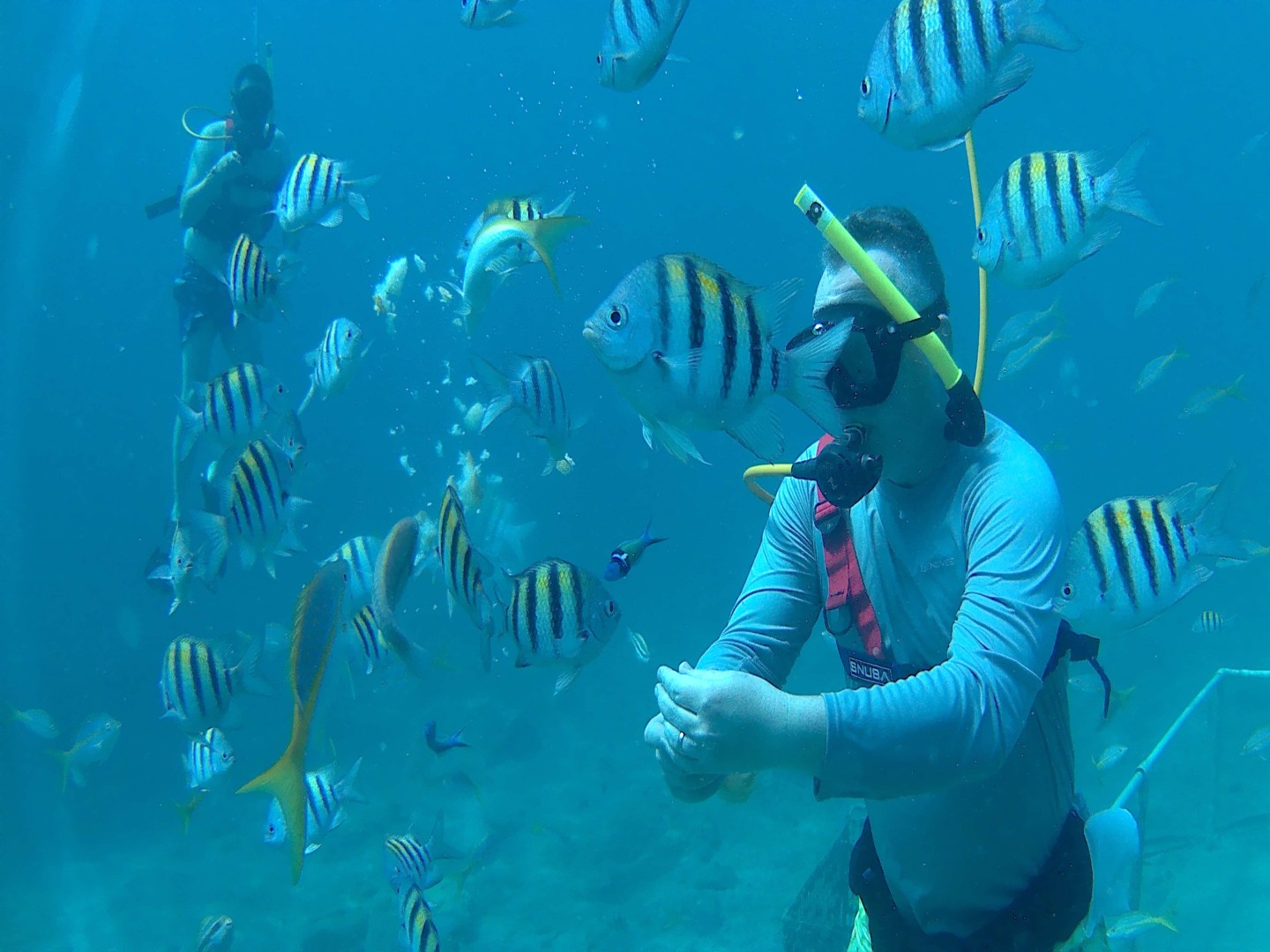
The most important part of a first underwater experience often happens
before anyone’s face touches the sea.
It happens on the edge of the marina, while a visitor is still deciding
whether nervousness is a warning or simply the body’s way of paying
attention. It happens during the briefing, when unfamiliar equipment
becomes a series of small, understandable objects: a mask, fins, a
harness, a regulator, and a hose leading to an air supply floating on
the surface. It happens when a guide answers the same question twice
without making the guest feel foolish for asking.
Sint Maarten is an island that invites quick plans. Cruise passengers
arrive with a limited day. Visitors staying on the island have beaches,
restaurants, viewpoints, and neighborhoods competing for attention. The
temptation is to compress every experience. Underwater, that instinct is
rarely helpful. The sea rewards a slower transition.
A practical first step is simply to arrive early. SNUBA SXM operates
from the marina side of Philipsburg, close enough to the cruise port for
a short walk, but island traffic and ship-day crowds can still change
the pace of a morning. Giving yourself extra time means the tour begins
with a conversation rather than a sprint.
The briefing is not a delay before the activity. It is the first part of
the activity. A good guide explains how to breathe through the
regulator, how to clear a mask if water enters, how to communicate
without words, and how to move without fighting the water. The guest
should know that there is time to pause and that comfort matters more
than keeping up with someone else.
SNUBA uses a surface-supported air system. The air supply stays on a
raft above, while a lightweight hose connects the participant’s
regulator to that supply. There is no scuba tank on the back and no
scuba certification is required for eligible beginners. Participants
remain in shallow water and close to their guide. Children age eight and
older may be eligible, although every participant should review current
requirements and answer medical questions honestly before joining.
Then comes the moment people imagine as a leap. In practice, it is
better treated as an ordinary breath.
Put your face in the water. Exhale. Inhale. Listen to the bubbles.
Notice that the regulator keeps providing air. Look at the guide. Stay
where you are until breathing feels less like a task. There is no prize
for descending quickly.
This is where individual differences become visible. One guest wants to
move forward almost immediately. Another needs several minutes at the
surface. A child may be curious but cautious. An adult who has spent
years insisting that they are “not a water person” may discover that the
hardest step was simply allowing enough time for the body to believe the
equipment.
Once the breathing rhythm settles, attention widens. The mask is no
longer the center of the experience. The shallow underwater route begins
to show itself: fish passing through, sunlight changing over sand and
reef growth, mooring structures becoming habitat, and other participants
moving in three dimensions rather than walking along a path.
Most guided SNUBA experiences in Sint Maarten take about two to two and
a half hours from welcome to goodbye, including briefing, practice, and
the underwater portion. The activity generally stays within a shallow
range of roughly 10 to 20 feet. Those numbers are useful for planning,
but they do not explain why a first underwater breath stays in memory.
The lasting part is the change from anticipation to ease.
Visitors should bring swimwear, a towel, drinking water, and
reef-conscious sun protection. They should also bring questions. Current
times and availability can change with operations and sea conditions, so
the direct SNUBA SXM booking page is the right place to check the live
calendar: https://snubasxm.com/book-snuba/
After the underwater portion, leave room for the experience to land. Dry
off, drink something, and listen to what each person noticed. One guest
may remember the sound of bubbles. Another may remember a fish that
hovered close. Someone else may be quietly proud of having done
something they had spent the morning considering backing out of.

That half-hour before the first underwater breath is not empty waiting
time. It is the bridge between imagining the sea and entering it. When
it is handled calmly, the first breath does not need to feel heroic. It
can feel normal – and that is often what makes the rest of the
experience possible.
Author disclosure: Michel Wouterse is the owner of SNUBA SXM and writes
from the perspective of a local underwater-tour operator.
About the author: Michel Wouterse has lived and worked in Sint Maarten’s
underwater tourism community since 2008. He is the owner of SNUBA SXM
and writes about first-time underwater experiences, small-group guiding,
and the practical details that help visitors enjoy the sea with
confidence.
All photographs courtesy of/credit to Michel Wouterse / SNUBA SXM.